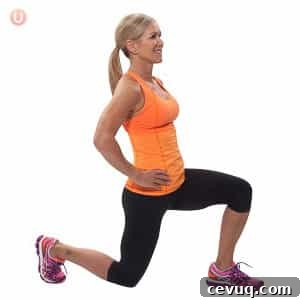
Mastering the stationary lunge (also called the static lunge) is an efficient way to strengthen your entire lower body. These lunges can be done almost anywhere—even during a walk with friends—to build firmer glutes, stronger legs, and better balance.
Because the movement requires keeping a tall spine and steady balance, it also challenges your core. Tightening your abs to maintain alignment improves posture and reinforces hip and lower-back stability.
Below you’ll find clear instructions, useful tips, and ways to add stationary lunges into your workouts so you can develop toned, functional legs.
Stationary Lunge Exercise Instructions
Follow these steps to perform a proper stationary lunge:
- Stand tall with feet hip-width apart. Take a large step backward with one foot—this is your starting position.
- Lower your back knee until both knees form roughly 90-degree angles. Keep your front knee aligned over the ankle.
- Press through the front heel and return to the starting position. Complete the desired number of repetitions, then switch legs.
Stationary Lunge Tips:
Key pointers to maintain good form and get the most from this move:
- Keep your chest lifted, chin neutral, and abs engaged to protect your spine.
- Balance on the toes of the back foot while ensuring the front knee tracks over the ankle, not forward past the toes.
- Squeeze your glutes as you push back up through the front heel. Start with about 12 repetitions per leg using body weight only.
- Progress to three sets as your strength improves. To make the exercise more challenging, hold dumbbells at your sides or rest a barbell across your shoulders.
Easy Ways to Incorporate Stationary Lunges Into Your Workouts
Here are a few workout ideas and programs where stationary lunges fit well:
- Include lunges in total-body strength routines or lower-body focused sessions to increase volume and endurance.
- Add them into circuit workouts—pair lunges with pushes, pulls, and core moves for a balanced session.
- Use lunges as a finisher at the end of a workout to fatigue the legs and boost metabolic demand.
If you want variety, try these effective lunge variations as progressions or alternatives:
- Walking Lunge
- Lateral Lunge
- Elevated Lunge
- Cross-Behind Lunge
- Backward Lunge
Benefits of Stationary Lunges
Stationary lunges offer multiple benefits and are worth adding to regular training. They improve strength, shape, and movement quality for everyday activities.
Primary benefits include:
They Work All Your Leg Muscles
Performing lunges from a fixed stance targets the full lower-body chain—quads, hamstrings, glutes, and calves—without high impact. This makes stationary lunges a joint-friendly option that still builds muscular strength and endurance.
They Tone Your Glutes
Because the movement emphasizes pressing through the heel of the front foot, stationary lunges are especially effective at activating the glutes. This helps train the muscles to “fire” properly, contributing to stronger, firmer hips and improved function.
They Improve Your Balance And Stability
Balancing with one foot forward and one foot back challenges your core and stabilizer muscles. Keeping the torso upright and the abs engaged during the lunge trains balance and overall postural control—beneficial for both sport and daily life.
What Muscles Do Stationary Lunges Work?
Stationary lunges engage the major muscles of the lower body—glutes, quadriceps, hamstrings, and calves—making them a highly efficient no-equipment exercise. They can be performed using only body weight or intensified by adding resistance, such as dumbbells or bands.
If you want to vary resistance, try resistance band squats or stationary lunges with dumbbells as natural progressions.
How Many Calories Do Stationary Lunges Burn?
Calorie burn varies by intensity, body weight, and effort. As a rough estimate, performing lunges continuously can burn around 100 calories per 10 minutes of work. Increasing pace, adding resistance, or combining lunges into higher-intensity circuits will raise calorie expenditure.